[10/08/2019] Asymmetrical Neighbors: Borderland State-Building between China and Southeast Asia


“Asymmetrical Neighbors: Borderland State-Building between China and Southeast Asia”
For event photos, click here.
Event Description
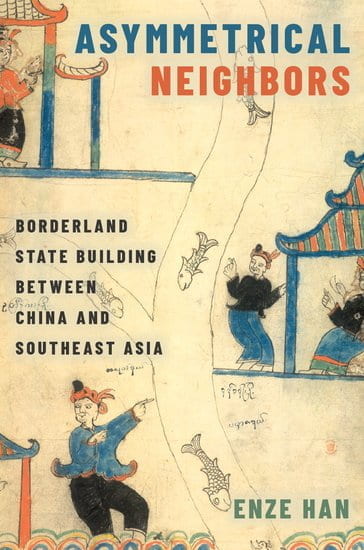
The East Asia National Resource Center welcomes you to join us for the book launch of Enze Han’s Asymmetrical Neighbors: Borderland State-Building between China and Southeast Asia.
Abstract
Is the process of state building a unilateral, national venture, or is it something more collaborative, taking place in the interstices between adjoining countries? To answer this question, this book takes a comparative look at the state building process along China, Myanmar, and Thailand’s common borderland area. It shows that the variations in state building among these neighboring countries are the result of an interactive process that occurs across national boundaries.
Departing from existing approaches that look at such processes from the angle of singular, bounded territorial states, the book argues that a more fruitful method is to examine how state and nation building in one country can influence, and be influenced by, the same processes across borders. It argues that the success or failure of one country’s state building is a process that extends beyond domestic factors such as war preparation, political institutions, and geographic and demographic variables. Rather, it shows that we should conceptualize state building as an interactive process heavily influenced by a “neighborhood effect.” Furthermore, the book moves beyond the academic boundaries that divide arbitrarily China studies and Southeast Asian studies by providing an analysis that ties the state and nation building processes in China with those of Southeast Asia.
Speaker
Enze Han
Associate Professor, Department of Politics and Public Administration, University of Hong Kong
Date & Time
Tuesday, October 8th, 2019
12:30 PM-1:45 PM
Location
Chung-wen Shih Conference. Room – Suite 503
Elliott School of International Affairs
1957 E Street, NW, Washington, DC 20052
Note: This event is free and open to the public. This event is to support the launch of Enze Han’s book entitled Asymmetrical Neighbors: Borderland State Building between China and Southeast Asia.

Enze Han is an Associate Professor at the Department of Politics and Public Administration at the University of Hong Kong. His research interests include ethnic politics in China, China’s relations with Southeast Asia, and the politics of state formation in the borderland area between China, Myanmar and Thailand. Previously he was Senior Lecturer at the Department of Politics and International Studies at SOAS, University of London. His research has been supported by the Leverhulme Research Fellowship, and British Council/Newton Fund. During 2015-2016, he was a Friends Founders’ Circle Member of the School of Social Science at the Institute for Advanced Study in Princeton, USA. He is the author of Asymmetrical Neighbours: Borderland State Building between China and Southeast Asia (Oxford University Press, 2019), and Contestation and Adaptation: The Politics of National Identity in China (Oxford University Press, 2013).